Total Pageviews

Saturday, January 14, 2012

A wonderful day down at the farm

Several weeks ago, Jim Somers from the CHM dropped in with a special request.

There was a young man (David) and his girl friend (Julie) who would like to visit the museum. The problem is he is blind.
Since the 1401 restoration room is the only place in the museum that has equipment that can be 'touched', Jim asked if he could schedule the vist for Saturday, January 14th which is one of our work days.


We told Jim that was no problem and bring David in.

The Wednesday before that date, we were working on the German 1401. It had several card failures.
Late in the day, the Connecticut machine decided to fail.

On Friday, I convinced Jim Hunt to join me at the CHM to try and get one of the machines up and running for Saturday.
 Jim Hunt fixing another IBM 1401 SMS cards.

Stan Paddock getting his finger stuck in some piece of equipment.

After spending the day working on the German machine, we were not able to make it work. We thought we were close to the answer when we started but were not successful

On Saturday, Ron Williams, Bob Edwards, Jim Hunt, Gary Feierbach, and myself came in early to attack the problem.
 Ron Williams working on the Connecticut machine's problem.
Bob Erickson working on a different problem.

Ron, Bob and myself worked on the Connecticut machine while Gary and Jim worked on the German machine.

Jim McClure, from the museum staff, was escorting David and Julie through the rest of the museum. At noon, I went to find them and let them know we were still down and maybe they should wait until after they had lunch to come in to the 1401 room. They said OK. 

When I returned to the 1401 room, Ron informed me that the Connecticut machine was back in operation.
I went back out on the floor and invited Dave and Julie into our room.

Understanding David's limitations, we gave him a modified tour where he was allowed to touch the machines involved and even inside of the IBM 1402 where the cards passed through rubber rollers into pockets.
David was given our sample core memory module and he could feel the actual ferric core beads.
We ran the 'Big Print' program for David and Julie and 'Powers of 2'.
David ran his fingers over his name punched onto an IBM punched card and was told how to decode the punched holes. He thought that was cool.
While he could not read the printout of 'Powers of 2', he was impressed by the noise of the IBM 1403 printer.

I hope David and Julie enjoyed the tour as much as we did presenting it to them.

Stan Paddock

Sunday, January 8, 2012

A special Visitor

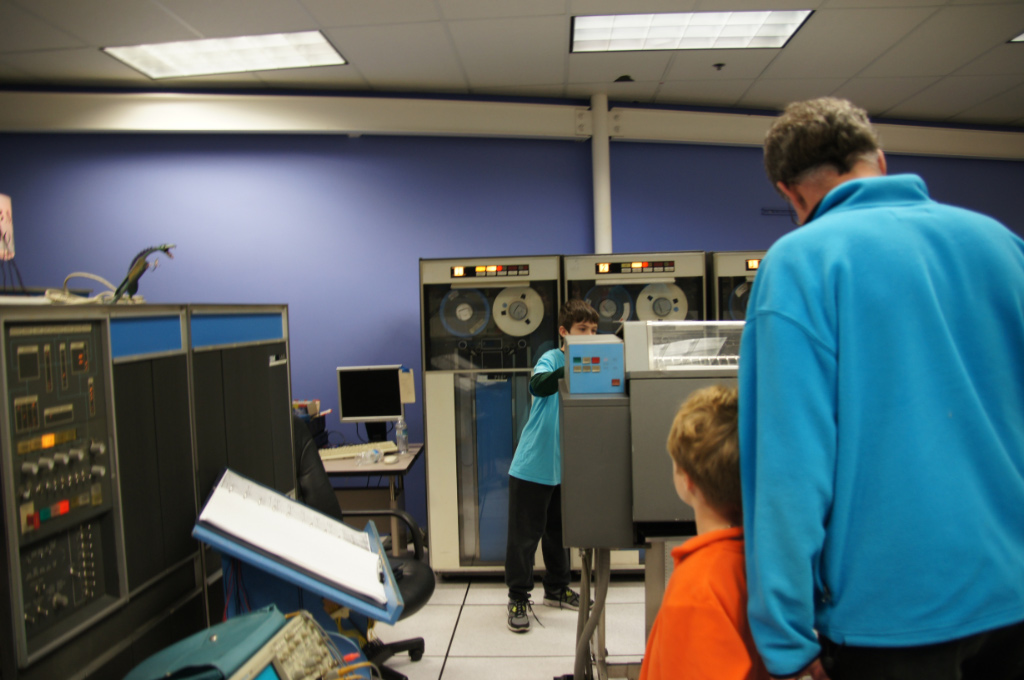
On December 28, 2011, The Husman family came all the way from Northridge CA to visit the Computer History Museum at the request of their 10 year old son Glen.
This picture shows Glen, his younger brother and his father. His mother is busy taking pictures.

Glen was very interested in the IBM 1401 equipment. He showed me the programming he had done on his cell phone!

I had some work to do at the CHM and invited Glen to com back on Friday and I would teach him how to program the 1401. He and his mother accepted.


After a whiteboard session upstairs, Glen wrote a "Hello World" program on the IBM PC in the foyer.
He and his mother are shown above.

Glen then ran the program through the IBM 1401 simulator on the IBM PC.
The Glen ran "remote punch" to punch his object deck on one of the IBM 026 keypunches.
After he was shown how to load a program into the IBM 1402 card reader, he did so and the program ran as expected.

Glen was so excited with his success, he decided to write a program that read cards and put the data to the printer with a header for each line. There was an "(EOF)" card at the end he had to detect to stop the program.
This program also worked as designed.
Glen was fascinated that the IBM 1401 system has four "START" buttons so when he demoed his program, he used all of them.

I received the following E-Mail from Glen after he returned home.
I think I may have found a JAVA programmer to fix the problem with our ROPE programming environment!

Dear Stan,
    Thank you for teaching me how to program the IBM 1401 (Ancient) Computer. I enjoyed it very much. The Computer History Museum was, by far, the best museum I have ever been to. Thank you for inviting me back to program the IBM 1401. I will definitely like simulating, and programming for, the IBM 1401 at home. I will also like fixing that bug in the simulator, and, maybe adding a new feature, punching directly from the simulator program (so I can click "Punch" on the assembled code screen, and it will punch for me)! Speaking of which, I loved the remote punch feature! Thank you for inviting me.

Sincerely,
    Glen H.

Thursday, May 26, 2011

Full Restoration of The Connecticut 1401 at the Computer History Muesum

When the Computer History Museum received the Connecticut 1401 system, the covers for the reader end of the IBM 1402 were missing.
While the machine was fully functional with the missing covers, for safety reasons and aesthetics we decided to find some covers.
We searched the CHM warehouse and all known sources of IBM card reader parts and could not find any of the required parts.
The right hand cover shown above was found in the parts that came with the Connecticut 1401 system.

The lower shelf was fabricated by Stan Paddock with help from Bill Flora, Sam Seibert (San Jose History Museum), Paul Williams (San Jose History Museum) and George Ahearn.


Bill Flora is shown here trying to figure how to get the support brackets into the IBM 1402.

The left hand cover was manufactured by the IBM Almaden research facility with help from Robert Garner. George Ahearn took some of the parts home to his garage machine shop to fine-tune the fit. George Ahearn is shown here adjusting the bolts so everything aligns correctly. Some unique paint was found locally to give the parts the rough finish that IBM used for the rest of the machine. 


This is a picture of the card reader end of the Connecticut IBM 1402 with all of the covers in place.

 This picture is of the completed Connecticut 1402 with some of the people responsible for the work.


I would like to thank all of the people involved in the fabrication and assembly of the parts to complete the Connecticut 1402.


Stan Paddock


Tuesday, May 24, 2011

Wednesday May 18, 2011

Attendees: Ron Williams, Bob Erickson, Robert Garner, George Ahearn, Stan Paddock, Bill Flora, Frank King, Glenn Lea, Douglas Martin, Bill Newman, Joe Preston, Ed Thelen, Jim Hunt, Ron Crane, Judith Haemmerle


Ed Thalen, Frank King and Bill Flora have been working on a problem with the German machine. A very little used instruction "Branch on printer busy" did not work. After tracing the ALDs, they found and replaced the failing card.
I am sure the fact that the German machine cannot load and execute programs has nothing to do with their fix.


Bob Edwards fixed a couple of mechanical problems with the IBM Transmitting Typewriter.
Bill Newman, Doug Martin, George Ahearn, Jim Hunt and Stan Paddock worked on wiring the switches in the typewriter.
Bill Newman and Stan Paddock tested the wiring and made some corrections. The typewriter was connected to Bill's Arduino. All of the typed characters sans two worked!!!
Next week the last of the special switches will be wired and tested and then wiring of the solenoids will begin.
Joe worked on both the second and third tape drives of the German machine. Test will be performed next week.
While it may look like they are working on the typewriter, Bob Edwards, Judith Haemmerle, and Bill Williams are working on a 'Williams' tube prototype.
http://en.wikipedia.org/wiki/Williams_tube

Stan Paddock

Wednesday, May 4, 2011

Wednesday May 4, 2011

Attendees: Ron Williams, Bob Erickson, Robert Garner, George Ahearn, Stan Paddock,  Frank King, Glenn Lea, Douglas Martin, Bill Newman, Joe Preston, Ed Thelen, Jim Hunt, Ron Crane, Judith Haemmerle and Don Luke.

Visitors: Five visitors found there way into the IBM 1401 restoration room for an informal visit.
Taking advantage of the warm weather, we enjoyed lunch in front of the Computer History Museum. We had the pleasure of John C Hollar, President & Chief Executive Officer, of the museum join us for lunch. (The only one with a shirt and tie.).


 Several months ago, Stan Paddock misplaced his leather hat. This is a common event and most of the time the hat never returns.
Last Week, Dave Wood from the San Jose Fire Museum, found it in an old fire truck I had been driving. Before returning it, Dave felt it necessary to decorate it. Stan had to wear it for a week which included today.
Judith Haemmerle and Bob Erickson continued work on a Williams Tube memory prototype.
http://en.wikipedia.org/wiki/Williams_tube
Bill Newman and Ron Crane are also involved in this project.


Ron Williams and George Ahearn checked out the problem with the feed rollers on the Connecticut IBM 1402. To everyone's amazement, today it works just fine. 

Stan Paddock modified his Tape demo program to print while the tapes are spinning. The program performed different on the Connecticut machine from the German machine. The problem is associated with a little used instruction known as "Branch On Printer Busy."

Ed Thelen Don Luke and Glenn Lea are working to find the source of the error on the German Machine.


Joe Preston and Frank King repaired the head lift mechanism on tape drive number two of the Connecticut system. This brings the Connecticut machine back to 100% operational status.
A trip is planned in the next few weeks to retrieve the covers for the IBM 729 tape drives for the German machines. We are also going to try to retrieve some parts for use on our operational tape drives. Pictures and conditions for all our tape drives being stored will be recorded.

Ron Crane is continuing his study to reduce the reactive power being generated by the German system and documenting the  true power being used by the Connecticut machine. This information will be required for planning of the up coming modifications to the room.

Jim Hunt, and Doug Martin continued their work wiring the IBM Model B transmitting typewriter.  Bill Newman brought in the circuit board that will operate the typewriter when everything is complete.


Stan Paddock

Thursday, April 21, 2011

Wednesday April 20, 2011

Attendees: Ron Williams, Bob Erickson, George Ahearn, Stan Paddock, Frank King, Don Luke, Bill Newman, Joe Preston, Ed Thelen, Jim Hunt


Ron Williams shows off the finer points of an IBM 1403 printer to Ed Thalen. Ed still thinks the printers made by GE were better in that their failure rate kept him gainfully employed.


Joe Preston, Jim Hunt and Frank King discuss the finer points the installation of a cotter pin.


This is the card reader end of the Connecticut system as we received it. While operational, it leaves lots of spaces for fingers to be caught.


This is the same end with the right shoulder installed. The part was inside the machine when we received it. The part was sand blasted and re-painted to mach the two new parts.


The bottom support plate was fabricated by Stan Paddock, Sam Seibert, Paul Williams and George Ahearns.


This picture shows George Ahearns attaching the newly fabricated left shoulder. We are very thankful to IBM Almaden  for fabricating this part using the same part borrowed from the German IBM system as a pattern.

 Joe Preston read through all of the manuals for the IBM 729 tape drive to find the last problem with the number three tape drive on the German system. When Joe left today, his tape drive was fully functional for the first time since we have received the system.


Stan Paddock

Monday, April 18, 2011

Wednesday April 13, 2011

Attendees: Ron Williams, Bob Erickson, Robert Garner, George Ahearn, Stan Paddock, Bill Flora, Frank King, Glenn Lea, Don Luke, Douglas Martin, Bill Newman, Joe Preston,  Allen Palmer, Jim Hunt, Ron Crane, Judith Haemmerle

Visitors: a mother and her daughter. The daughter was in a school play as Grace Hopper.
Stan made a presentation to this Mother and Daughter pair.
Frank King provided hands-on training to the daughter.


The German 1402 had a non-operational  “Reader Stop” lamp.
Bill Flora opened the doors, checked the wires,  found the problem and fixed it.


The German 1402 did not feed cards right from the big feed stacker.
Bill flora and Ron Williams found that problem and fixed it.
The Connecticut 1402 did not feed cards right form the big feed stacker.
Bill flora Showed George Ahearn where to look and George fixed it.


George Ahearn brought in the card feed tray from home.
Stan further modified it to allow space adjustment.
Stan brought in the new end piece for the Connecticut 1402.
George assembled all of these new parts on the Connecticut 1402.
While everything was close to be perfect, George decided that a little more machine in his home shop would make it perfect.
George took both parts home for final touches.
Jim hunt researched the problem with the X sync pulse not appearing on the control panel of the Connecticut 1401.
After studying the ALD’s, Jim suggested running the system with the punch turned on.
 That fixed the problem. Why?, we are not sure. Robert garner and Jim talked about it for some time with no idea coming up.
Allen Palmer came in and fixed a high speed rewind problem on the second IBM 729 tape drive of the German machine.


Allen worked with Joe Preston on the third tape drive of the German machine.
Allan had to go home and Bill Newman worked with Joe on this strange problem.
Then Joe Preston had to go home and Bill Newman told Ron Crane about the problem.
Ron crane found a bad reading on one of the lines that generate the universal reference voltages in the tape drive.
Ron pulled the power supply out of the machine and found a loose lead to the main transformer.
He soldered the lead back and the machine came back to life.
Joe should be happy when he comes back in on next Wednesday.
Ron Crane has figured out the correct values to add to the power lines on the German 1401 system to correct the power factor.
Now he is looking for a place to mount the capacitors. The three caps shown might be a bit small for his needs.


Bob Erickson and Frank were talking about power indicator lights on the IBM 077 collator.
 Frank was able to remove the existing light and gave it to Ron Crane.
On went back to his stash of various light bulbs and found a match. We installed the light and tested it. It is strange that the light is on when the machine is on and the machine is not running.

This was a great day for the IBM 1401 Restoration Team. Eight problems were resolved in the same day. 

Stan Paddock