Total Pageviews

Sunday, March 20, 2011

Wednesday March 16, 2011


Attendees: Ron Williams, Bob Erickson, Robert Garner, Stan Paddock, Bill Flora, Frank King, Don Luke, Douglas Martin, Bill Newman, Joe Preston, Ed Thelen, Allen Palmer, Ron Crane, Judith Haemmerle
Visitors: Johann Gunnarsson, Stephen Somerstien and several lost Computer History Museum visitors.

Johann Gunnarsson is the leading long distance visitor to the CHM IBM 1401 Restoration room. He lives in Iceland and in the 1960s maintained all of the IBM 1401 computers in Iceland. (2)
Johann Gunnarsson’s son Jóhann Jóhannsson was fascinated with the IBM 1401 and wrote a musical piece "IBM 1401 A User's Manual". This was played on one of the IBM 1401s before it was shut down for the last time. An interesting piece can be seen on http://www.youtube.com/watch?v=whvzDJGt-fk.
A sample of our own IBM 1401 playing music can be heard at: http://www.paddockdrayage.com/IBM1401PlayingMusic.wmv.
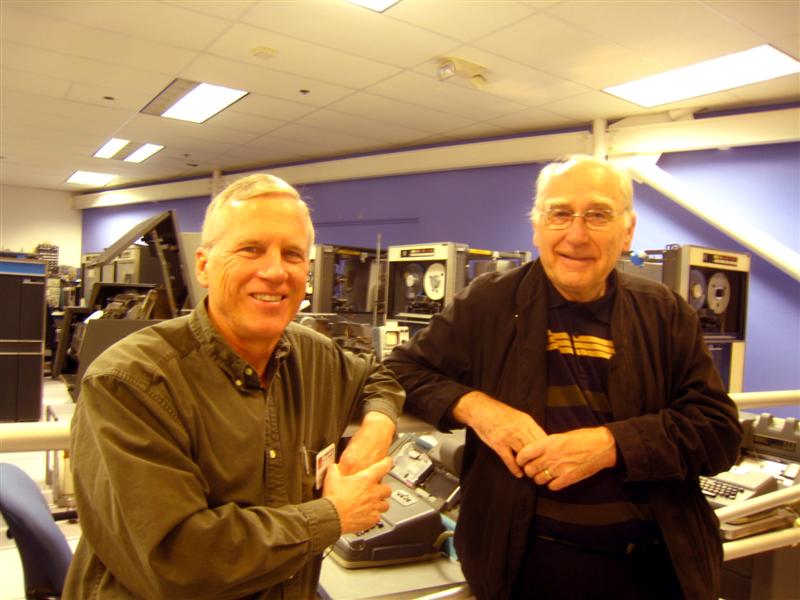


Robert Garner and Johann Gunnarsson are shown above in the IBM 1401 Restoration Room at CHM.


To make Tape Drive Three on the German IBM 1401 work right, you have to get right down to the internal problems. That is what Joe Preston is doing above.


Ed Thelen and Bob Erickson continue to work on the IBM Model B typewriter. Why Ed thinks you need a big Tektronix oscilloscope for this mechanical device, I have no idea.


Robert Garner, Ron Williams and Bill Flora have found something funny to laugh about. The Connecticut 1402 still has a lingering problem with the card reader so that must not be it.

Stan Paddock

Tuesday, March 15, 2011

Saturday, March 12, 2011

Attendees: Ron Williams, Bob Erickson,  Stan Paddock,  Judith Haemmerle 
Due to technical difficulties, the video portion of this blob continues to be interrupted.
Ron Williams and Stan Paddock continue to work on the Connecticut 1402 card reader. We are getting closer but have not found the cause of the problem.

Bob Erickson and Judith Haemmerle continue their work on the IBM Model 'B' transmitting typewriter. Almost all of the keys will cause the type bars to strike the paper and leave a good impression.

Stan Paddock

Wednesday March 09, 2011

Attendees: Ron Williams, Bob Erickson, Robert Garner, George Ahearn, Stan Paddock,  Frank King,  Douglas Martin, Bill Newman, Joe Preston, Ed Thelen, Allen Palmer, Ron Crane, Judith Haemmerle 
Due to technical difficulties, the video portion of this blob has been interrupted.
While pictures were taken on March 9th, the camera used to take the pictures has decided to hide. Anyone knowing the whereabouts of the silver Kodak camera is urged to notify your local police department.
Allen Palmer and Joe Preston continue their work on tape drives number two and three of the German IBM 1401 system.
Bob Edwards and   Judith Haemmerle continue their work on the IBM Model 'B' Transmitting typewriter.
Ron Williams continue on the read problems associated with the Connecticut IBM 1401 system. Every other card that has an odd number of rows punched will be flagged as an error. For those of you that know IBM 1401 systems, this is a error associated with the 'X' check memory plane.
Ron Crane and Stan Paddock continue to work on the power input to the German IBM 1401 system. The power distribution was as follows.
German IBM 1401, 1402, 1403, 1406, (1) 729 220/380 3Ǿ 50 Cycles 10.85 2,387.00 53.06%
220/380 3Ǿ 50 Cycles 7.05 1,551.00 34.47%
220/380 3Ǿ 50 Cycles 2.55 561.00 12.47%
Total of three phases 20.45 4,499.00 100.00%

Ron investigated and found the fans (35) were all powered from lea 'A'.
We moved the fan load from leg 'A' to leg 'C'. The power distribution is now as follows:
German IBM 1401, 1402, 1403, 1406, (1) 729 220/380 3Ǿ 50 Cycles 6.80 1,496.00 32.03%
220/380 3Ǿ 50 Cycles 7.01 1,542.20 33.02%
220/380 3Ǿ 50 Cycles 7.42 1,632.40 34.95%
Total of three phases 21.23 4,670.60 100.00%
It does not get any better than that.
Now that the legs are balanced, we will work on the power factor. With the leg load and power factor controlled, the loading on the Pacific power converter will be much lower.
During our tests, we found that two of the linear amplifiers in the converter are not performing up to their full ratings. These will be fixed or replaced from our spares.


With an invitation from Karen Kroslowitz, Bill Newman and Doug Martin visited the CHM warehouse in Milpitas. They were looking for some interconnecting cables for the IBM Model 'B' Transmitting typewriter. Two matching typewriters were found but they were both associated with the stored IBM 1620. While they were offered to us because they were already 'service' status, Bill and Dough did not want impact a future revival of the 1620.
There is a section of the Connecticut IBM 1402 that has been missing since we received the machine. While it is not required for the functioning of the machine, it does expose some electrical and mechanical dangers to the operators.
We removed the missing pieces from the German IBM 1402 and Bill and Doug took them with them to the warehouse to see if any of the stored IBM card machines matched what we need.
The guys found several close calls but only the IBM 1402 from Visible storage had the right parts. These are not available to us as it is a part of the permanent collection.
We had three couples who found there way down the hall and wondered what was going on in the 1401 Restoration room. They got the usual "Data Processing in the 1960s" dog and pony show. They seemed to enjoy it as much as I enjoy giving it. 
 

Saturday, March 5, 2011

Saturday, March 05, 2011

Attendees: Ron Crane and Stan Paddock.

Ron Crane and I have been working on the strange power consumption for the German IBM 1401.
Ron called me up this morning and asked if I would like to come in today when we would not bother anyone else. I said yes.

What we learned:
  1. Both the Connecticut and German machines have 4 Ferro-resonance transformers. 2 in the 1402, 1 in the 1401 and one in the 1406.
  2. The Connecticut machine runs on three phase 120/208 60 HZ power.
  3. The Connecticut machine runs the Ferro-resonance transformers by connecting them between two legs of the input power. (208 volts)
  4. The German machine runs on three phase 280/380 50 HZ power. To minimize the input voltage to the Ferro-resonance transformers, the Ferro-resonance transformers are connected from a leg of the input power to neutral. This supplies each one 220 V instead of 380 V if they were connected leg to leg like the Connecticut machine.
  5. If we determine the power of each Ferro-resonance transformer, we could switch the source to one or more and thereby balance the total load to the German machine.
  6. We also have to determine how the inputs to the Ferro-resonance transformers map back to the input power.
Stan Paddock

Wednesday March 02, 2011

Attendees: Ron Williams, Bob Erickson, Robert Garner, George Ahearn, Stan Paddock,  Frank King, Don Luke, Douglas Martin, Bill Newman, Joe Preston, Ed Thelen, Allen Palmer, Ron Crane, Judith Haemmerle
Guest: Bill Kell; My Father-in-law from Carson City, NV
 Having spent most of his career making computers and other electronics work, Bill had little trouble punching his name into a punched card on one of our 026 Keypunches.
Bill had a discussion with Doug Martin only to find out that they both spent considerable time doing support at the same over seas site.
It was a tape drive day. Allen Palmer continues on fixing the brake on the second IBM 729 for the German system
Joe Preston continues to work on the third IBM 729 for the German system. Joe has taken this machine from totally dead to being able to load a tape and I saw it writing data. Now if that data was good data ..........
Frank likes the IBM 1403 printer. When he heard a bad bearing in the IBM 1403 connected to the Connecticut system, he tore into it to get to the bad bearing. That is when he determined the bearing noise came from the IBM 729 directly behind the printer.  Frank found the offending bearings and is in the process of replacing the bearings with new bearings.
Ron Crane continues his quest to make the input power correct to the German machine.
While checking power supplies, Ron found the comment above written inside one of the gates. We are going to the CHM staff for a translation.
In our quest to find all of the problems with the Connecticut IBM 1402 card reader, we found one of the transistors  was weak. We found a match on E-Bay and bought it. The picture above is Bill Newman installing the transistor inside the bowels of the 1402. We have fixed several bugs in this area but still have at least one more to go.
Judith Haemmerle and Bob Erickson are working on the IBM Model 'B' transmitting typewriter that will be attached to the Connecticut system as an IBM 1407 inquiry station. 


Stan Paddock

Monday, February 28, 2011

Saturday, Febuary 26, 2011

Attendees: Ron Williams, Bob Erickson, Stan Paddock,  Ed Thelen, Jim Hunt, Ron Crane 
Visitors: Goerner, Matthias (one of our 1401 volunteers) brought in two visitors. After visiting us, they went into the main exhibits and were there until the museum staff told them they had to leave since the museum was closing.  Ed Thelen provided automobile transportation to and from the Museum for the three of them.

We also had four museum visitors who found our door open and came in to see what was going on. 
They got the informal briefing on the equipment in the room.
============================================
Ron Crane has been studying the 'power factor' for the input power on the German machine. The top picture is a test setup where high voltage capacitors were connected to verify the amount needed to correct the power factor.
To measure the power factor, the current through a leg of the three phase power is connected to an oscilloscope along with the voltage. If they both peak at the same time, you have the desired power factor of 1.
We ran tests on the power going into the Connecticut machine and the German machine.  The results are shown below.


German IBM 1401, 1402, 1403, 1406, (1) 729 220/380 3Ǿ 50 Cycles 10.85 2,387.00 53.06%
220/380 3Ǿ 50 Cycles 7.05 1,551.00 34.47%
220/380 3Ǿ 50 Cycles 2.55 561.00 12.47%
Total of three phases 20.45 4,499.00 100.00%


Connecticut IBM 1401, 1402, 1403, 1406, (3) 729 120/208 3Ǿ 60 Cycles 14.77 1,772.40 34.37%
120/208 3Ǿ 60 Cycles 12.20 1,464.00 28.39%
120/208 3Ǿ 60 Cycles 16.00 1,920.00 37.24%
Total of three phases 42.97 5,156.40 100.00%

We suspect the power factor  shift is related to the unequal loading of the three phases of power going into the German 1401. Research continues.
Bob Erickson is continuing to bring the IBM Model B transmitting typewriter back to life. We were able to get a new typewriter ribbon for the machine and installed it. When we plugged it in and tried to type, no ink transferred to the paper. At lunch, Bob figured out the primary problem. The nearest 110V socket to where the typewriter is located is on the back of the German 1401. That machine runs on 50 cycle power not the normal 60 cycle power. So the power roller that drives the print hammers was running at 50/60 normal speed.
After lunch, we plugged it into 60 cycle power and it worked much better. By the end of the day, Bob got almost all of the type hammers to work as designed.


Ron Williams was checking out the basic timing circuits on the German machine.He noticed a waveform that was not correct. While it did not seem to bother the operation of the machine, it was still wrong.
Ron and Jim Hunt found the card suspected of causing the problem. Jim replaced the transistor and the signal got worse! The question of what 'new' transistor matched the functionality of the old transistor spiked the interest of Ron Crane. The second picture shows Ron Crane testing available transistors to see if he can match the functionality.
Keypunch # 3 miss fed another card again while Bob Erickson and I were watching. It does this about one time out of a hundred. Bob and I took the feed mechanism apart and replaced the feed knives with feed knives from the keypunch carcass. Appears to work fine now.
When I arrived to the Computer History Museum on Saturday,  I could not access the external employee door or the two doors into the 1401 Restoration lab. I had to get Museum staff to bring a key and unlock the two doors to the  1401 Restoration lab. We left the doors blocked open all day since we could not get back in if we closed them over lunch. We have been told that this issue is being addressed.
Stan Paddock


Sunday, February 27, 2011

Wednesday Febuary 23, 2011

Attendees: Ron Williams, Bob Erickson, Robert Garner, George Ahearn, Stan Paddock, Bill Flora, Frank King,  Don Luke, Douglas Martin, Bill Newman, Joe Preston,  Ron Crane

Frank King heard a noise from the IBM 1403 attached to the Connecticut system.
After removing the main cover and other parts surrounding the top blower motor
 , he decided the noise was coming from the IBM 729 tape drive behind the IBM 1403.
Frank then put the 1403 back together and started looking for the noise in the IBM 729 tape drive.


Don Luke continued his efforts to build a course outline to teach the IBM 401 internals.

Ron Crane continued his evaluation for the power going into the German 308 volt 50HZ system.
The term Power Factor defines if the current waveform peak occurs at the same time as the voltage peak. The picture below is of one of the three legs going into the German System.


While this leg looks good, the other two legs show a considerable shift in the power factor.
Ron had brought in some small capacitors which he hooked to the first leg. The sum of theses capacitors (25Uf) cut the problem in half. With the installation of three capacitors of the correct size, the load to the power converter can be reduced by at least a kilowatt. This excess power has to be removed from the room via at least another kilowatt worth of Air Conditioning.
(to be continued.)

Robert Garner and George Ahearn discuss some historical publishing regarding early computers.

Ron Williams and Don Luke discuss the old times when the IBM 1401 was considered "State of the Art".


Ron Williams, Bob Erickson and Bill Flora look for a small missing "C" clip for the Connecticut 1402.


Bill Newman, Ron Crane, Bob Erickson and George Ahearn discuss the way they think an old IBM Model "B" transmitting typewriter works.
Stan Paddock